WILD & WONDERFUL WEDNESDAY : How to Have a Thought: A Walk with Charles Darwin by Nicholas Day & Hadley Hooper
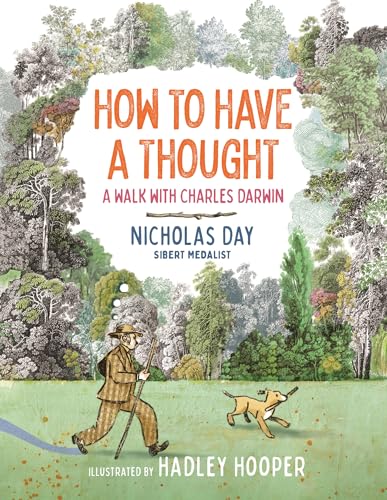
ABOUT THE BOOK
How do you work through a complicated idea, solve a tricky problem, or make a big discovery? Charles Darwin had a lot of ways to do it. He paced in circles and hit rocks with a stick. He studied the bones of his dinner. He even rode around the world on a boat called The Beagle.
These methods may sound unorthodox, but they led him to some pretty great thoughts—and discoveries about the origins of life as we know it.
Sibert Medalist Nicholas Day’s conversational text has all the charm of a true story told by your smartest, most interesting friend. With Hadley Hooper’s engrossingly textured illustrations, How to Have a Thought is both an introduction to Darwin and an invitation to live with brilliant curiosity.
REVIEW
How to Have a Thought isn't a typical picture book biography. While it revolves around Charles Darwin, it doesn't give his life story or a timeline. What the book does do, and does well, is share with young readers the methods Darwin used to develop his Theory of Evolution and encourage them to give them a try. The focus here is on the daily walks Darwin took in the park behind his residence. He would stack stones and he would knock the top stone off after each loop of the path until there were no more rocks to knock off. While he walked he thought and pondered, he even measured his problems in terms of walking and the number of rocks needed before he came up with a solution : one-rock problems, two-rock problems, etc. Naturally, the theory he is best known for took years of walking and letting his mind roam free before he was able to articulate his ideas. His journey on the ship the Beagle and the specimens he brought back provided a lot for him to ponder. Introductory information about Darwin's theory and what lead to it are provided, but the focus is on the methods he used that lead him to it. The author encourages young readers to try it themselves. "Here is how to have a thought: Stack your rocks high. Hold your stick firm. Throw your loop over the land. And step."
The illustrations provide a thought-provoking invitation to readers to let their minds wander. Using a combination of elements and styles the illustrator's images combine to create vintage images using a collage of her own drawings, various kinds of textures of fabric and patterns, along with photographic and historical pictures from the public domain. The result is a rather intriguing collection of elements that is reminiscent of Darwin's miscellaneous thoughts. Just as Darwin managed to collect his thoughts into coherent theories, the illustrator's & author's work blends into a fascinating combination of ideas that encourage young readers to develop and pursue their own questions and discoveries.
The way the book presents itself makes it especially appropriate for slightly older readers/listeners (8 and older). Teens and adults will also find some interesting things to contemplate, especially those who take the time to read the additional information found in the back matter. Recommended.


Comments
Post a Comment